It’s a new year so we thought we’d start the year off with a little fun and share some of the best jokes we could find poking a little fun at the marketing industry.
So put down your computer or pen, grab your favorite drink, and enjoy this little break and maybe you’ll chuckle a little.
1. How many marketers does it take to screw in a light bulb?
None – they’ve automated it.
2. Why did the social media manager bring a ladder to work?
To take their content to the next level!
3. What’s a marketer’s favorite exercise?
Running ads!
4. Marketer: Can’t we just use AI to manage our sales funnel for us?
Alexa: I found four places that sell funnel cakes close to you.
5. What is the safest place to hide a body?
The second page of Google.
6. Why did the marketer attend a yoga class?
To learn how to stretch the truth.
7. Knock, knock!
Who’s there?
Our new case study.
Our new case study who?
We only ask that you fill out the following 14 fields for a free copy of this punchline.
8. What did the SEO expert say to the website?
“It’s not you, it’s me. I just don’t think we’re ranking anymore.”
9. Why don’t marketers like trampolines?
They’re afraid of high bounce rates.
10. What do content marketers use to wrap presents?
White papers.
We hope you enjoyed some of these jokes and never take yourself too seriously!
If You Are Looking to Focus on Getting More Visibility, Traffic, Leads, Sales or Have Questions, Call Us at 866-357-7422
Over the past few years, TikTok has exploded in popularity, transforming from a niche video-sharing app into one of the world’s leading social media platforms. With its rapid rise, the app has attracted businesses, influencers, and marketers seeking to leverage its immense user base. It’s not uncommon now to see everything from beauty tips, cooking hacks, and personal finance advice to intricate manufacturing processes appear on TikTok feeds. While business-to-consumer (B2C) brands have eagerly embraced the platform, the question remains: should business-to-business (B2B) companies also dive into the TikTok arena? Let’s break down the data, demographics, and examples to help B2B organizations decide if TikTok is the right place for them.
How Popular is TikTok?
TikTok now boasts more than a billion active users worldwide, making it one of the fastest-growing social media platforms in history. The app’s parent company, ByteDance, has generated billions of dollars in revenue, partly thanks to TikTok’s robust in-app advertising options and growing brand partnerships. User engagement is exceptionally high, with the average user spending close to an hour per day scrolling through bite-sized videos. In addition, TikTok’s algorithm excels at delivering highly personalized content, ensuring that users remain deeply engaged. This combination of massive scale and addictive user experience has firmly solidified TikTok’s position as a key digital player, catching the attention of marketers from every corner of the business world.
What is the Primary User Demographic on TikTok?
The platform’s core audience skews younger, with a significant portion of TikTok’s user base under the age of 30. This demographic tends to be tech-savvy, highly visual, and open to discovering new brands and ideas via short, engaging video clips. In many cases, these younger professionals are either decision-makers in emerging startups, future entrepreneurs, or up-and-coming influencers in their respective industries. While older demographics are slowly joining the platform, TikTok’s youthful spirit and creative culture primarily appeal to a younger generation. This youthful energy can be advantageous for B2B brands looking to connect with the next wave of professional talent and potential clients.
Are Businesses Posting Content to TikTok?
Yes, many consumer-facing brands and even service providers are already posting frequently on TikTok. They use clever videos to showcase product features, highlight company culture, or provide how-to guides that engage audiences and spark conversations. This approach allows businesses to humanize their brand, offer behind-the-scenes looks at their operations, and build rapport with audiences who might otherwise remain distant. Some brands run hashtag challenges, work with influencers, and create trend-driven content to keep their presence fresh. With consistent effort, companies have managed to increase brand awareness, foster deeper customer relationships, and ultimately influence purchasing decisions.
Are B2B Companies Posting to TikTok?
Surprisingly, a number of notable B2B companies have embraced TikTok and experienced positive outcomes. Adobe, Shopify, Salesforce, Canva, Zapier, HubSpot, and Monday.com all maintain active TikTok profiles that mix education, entertainment, and community engagement. Their content often includes tips on using their platforms more effectively, thought leadership pieces, or even humorous takes on everyday business challenges. By participating in trending audio clips or video formats, these companies connect with viewers in a way that feels fresh and accessible. Such examples prove that even companies operating behind-the-scenes can create a relatable presence on TikTok.
Should Your B2B Company Post to TikTok?
The answer depends on the nature of your offerings and your target audience. If your B2B organization operates within technology, education, or design, you are likely to see tangible benefits by posting on TikTok. In these sectors, educational content, how-tos, tutorials, tips, and best practices, tends to perform incredibly well. Professionals searching for innovative solutions appreciate digestible video content that helps solve business challenges. However, if you’re in a more traditional or asset-based B2B industry, the benefits might be less direct. Maersk, for example, has done a remarkable job on TikTok, but this is more the exception than the rule. Generally, if you don’t see direct sales opportunities, you still have the option to leverage TikTok for brand building and attracting future talent.
B2B Companies Use TikTok to Grow Their Brand
For those willing to invest the effort, TikTok can serve as a powerful brand-building tool. By publishing highly tailored, creative content that stands out from competitors, B2B companies can highlight their unique value proposition and thought leadership. This might include sharing behind-the-scenes glimpses into product development, showcasing company culture, or presenting case studies in an engaging, visual format. Over time, such efforts can elevate brand recognition and help you carve a distinct place in your market’s mind. Ultimately, distinguishing your brand in a crowded space can drive long-term growth and opportunities.
B2B Companies Use TikTok to Attract Employees
Beyond clients, TikTok can also be a valuable platform for attracting talented employees. Creative content that introduces team members, shares day-in-the-life experiences, and outlines your company’s mission can help you connect with potential recruits. Younger professionals are more likely to consider employers who show authenticity, innovation, and a willingness to engage on platforms where they spend their time. By cultivating a strong employer brand presence on TikTok, your organization can become more appealing to those seeking a dynamic and forward-thinking workplace. This strategic move can help ensure your company continues to thrive with fresh, enthusiastic talent.
With the right approach, TikTok can become a compelling avenue for your B2B company to educate, inspire, and differentiate itself, ultimately paving the way for sustained growth.
If You Are Looking to Focus on Getting More Visibility, Traffic, Leads, Sales or Have Questions, Call Us at 866-357-7422
If you’re reading this, you’re likely currently running Lead Ads on Facebook or LinkedIn OR are trying to figure out how to set them up. One of the most critical steps to the set up process is ensuring any and all lead data captured from the ads are entered into your database so you can further segment, market and nurture those contacts.
Unfortunately there aren’t many native integrations from within the Ad platforms into most databases to get leads from one platform to the other so that’s why we’ve put this How To Guide together.
Integrate Facebook & LinkedIn Lead Ads Using Zapier
In order to properly get all lead data from Facebook and LinkedIn Lead Ads into your database, there are a number of steps you’ll need to take.
Set Up Zapier
The first step to the integration is creating and setting up a Zapier Account. Follow this link to create an account
Create A Zap to Integrate
Now that the account is created, you’ll need to create a Zap, which is the function that actually integrates Facebook/LinkedIn and your database. For the purpose of this article, we’re showing examples of connecting to LinkedIn Ads but the experience will be similar for Facebook Ads.
1. Click on Create then New Zap
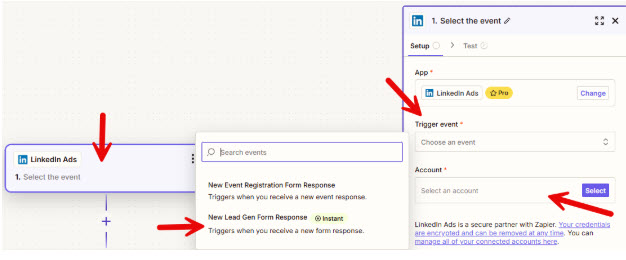
2. For the Trigger, click on the Trigger box then when the pop up box appears, search for either Facebook Ads or LinkedIn Ads (Note: these Ad Platform triggers are Pro Triggers which means you’d have to have an upgraded account in order to use them)
3. On the right side, there’s a box with settings you’ll need to make selections on.
4. For the Trigger Event, select New Lead Gen Form Response
5. For the Account, click on Connect A New Account. This will prompt you to login to your personal LinkedIn account.
a. Important Notes: It’s critical that you have a LinkedIn Ads/Campaign Manager Account created for your company to be able to move forward with this step. You’ll also need to make sure you personally, the person trying to set up the integration & Zap has access to the Ad Account.
6. Once logged in, click Continue.
7. Next, you need to Configure the Trigger. For Account, select the name of your LinkedIn Ad Account. For Lead Form, select the Lead Gen Form you want to use for this integration
a. Important Note: In order to complete this step, you’ll need to have your Lead Gen form already created inside of LinkedIn Ads.
8. You’ll then be prompted to Test your Trigger which we highly recommend doing. This ensures that your trigger was set up correctly. If you do not test in this step, it makes setting up the Action Step further down much more difficult.
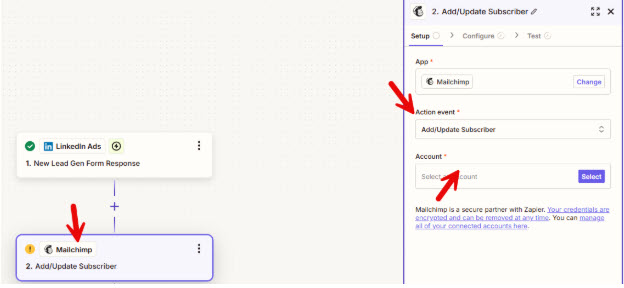
9. Now it’s time to set up the Action you want to take place once someone fills out the form which is in this scenario, getting entered into your database. For the purpose of this article, we’re using Mailchimp as the Database App.
10. Click on the Event box, then search the name of the database you want to connect LinkedIn Ads to.
11. From there, depending on the database, the available Action Events may vary. But what you want to look for is an event that is Adding a Contact or Subscriber.
12. Then you’ll need to login to your database in order to fully connect it.
13. Once logged in, click Continue.
The next grouping of steps is all for mapping the contact from LinkedIn or Facebook Ads into your database. Again, the selected database will determine what fields are available to be mapped but we’re calling out the most important ones here continuing to use Mailchimp as the example.
Select the Audience or List you want contacts from the Ads to be added to. (Note: You’ll need to have the audience or list already created in your database before it will be available to select in this step)
For the Email, either click in the field or click the plus icon and select the email address from the test record.
Make sure the Subscription Status is marked as Subscribed.
For Name, Email & Phone fields, either click in the field or click the plus icon and select those values from the test record.
If you are using Tags in your database for Segmentation, this is the step where you’ll apply those tags to leads that come from the ads. There should be a field for Tags where you can select what tag you want to apply to the contact.
Once all fields are mapped, click continue.
It will prompt you to test again and we highly recommend running a test to ensure the same test record that came through the Trigger, hits your database using the Action you just set up.
At this point, if the tests were successful, you can Publish your Zap and it will be live and fire the next time someone submits your Lead Gen form.
**There are a lot of options for other Actions and Filters you can create inside of Zapier such as setting up additional notifications that go to your team when someone submits the form so you can explore all of those if you wish.
Benefits of Integrating Your Ads with Your Database
Now that we’ve gone through all of the steps to actually integrating Lead Ads with your Database, you might be wondering why it’s even worth doing outside of just getting them into the system automatically without manual intervention. But there are some additional benefits.
Segmentation
We mentioned above that you may be using Tags inside your database to segment contacts based on their origin, industry, etc so ensuring contacts that come from Ads are added to your system and you know where they came from, allows you to better understand where they are at in their journey and you can send marketing messages out to them accordingly.
Lead Nurturing
Another benefit to getting lead ad contacts into your database is the additional opportunity to nurture them. These leads tend to be more passive, so they may not be ready to “buy” quite yet, but you can add them to a drip series where you share more about your company and offerings, stay top of mind, and hopefully get them to a place where they are ready to talk to you or better yet, purchase.
We’ve covered a lot of information here and used some specific platforms as examples to help give you the basics you need to get your Lead Ads and Databases integrated to better market those contacts and ultimately convert them!
If You Are Looking to Focus on Getting More Visibility, Traffic, Leads, Sales or Have Questions, Call Us at 866-357-7422